

Every week, patients walk into surgical consultation suites asking a common question: “Is fistula treatment without surgery possible?”
The promise of dissolving a perianal fistula using oral capsules, herbal tonics, homeopathy, electropathy, or local pastes is attractive. Naturally, anyone would prefer to avoid an operative procedure.
However, medical science and human anatomy tell a very different, uncompromising truth: there is no scientific, non-surgical cure for an established fistula-in-ano. Relying on alternative therapies, unproven medicines, or dietary supplements does not heal the tract—it simply delays necessary intervention, allowing a simple condition to turn into a destructive, complex surgical challenge.
Here is an honest, anatomical, and clinical breakdown of why an anal fistula cannot heal with medicine alone, the limitations of heavily advertised technologies, and what safe treatment actually entails.
What Is a Fistula-in-Ano and How Does the Tract Develop?
To understand why medicines cannot work, you must first understand the biological origin of an anal fistula (the cryptoglandular hypothesis).
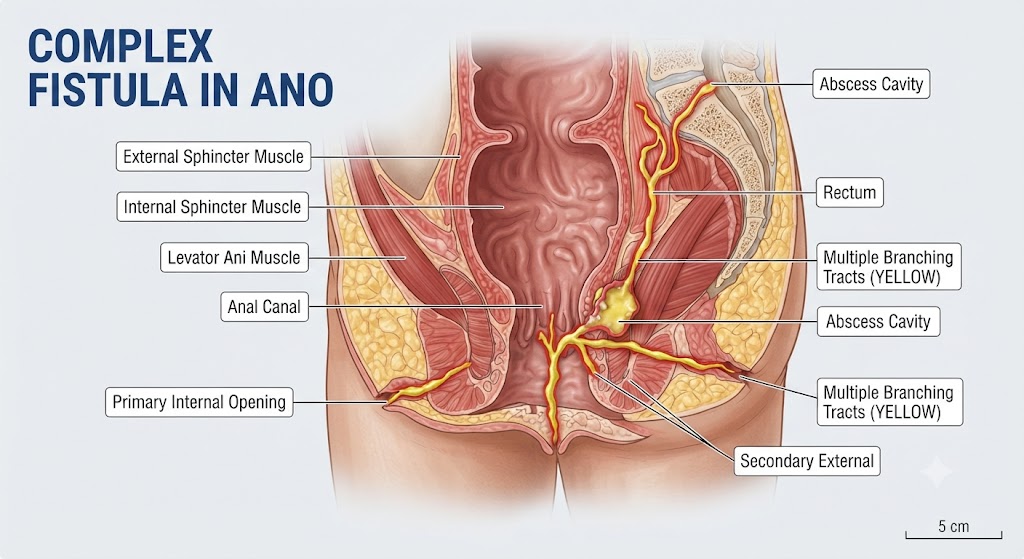
Inside the anal canal, at the level of the dentate line, lie tiny microscopic anal glands (crypts). When one of these glands gets blocked by hard stool, foreign particles, or bacteria, it becomes infected, forming an acute perianal or ischiorectal abscess (a pocket of pus).
When this abscess bursts spontaneously or is drained improperly on the outer perianal skin, the underlying cause is rarely solved. A persistent, hollow, abnormal epithelialized tunnel forms—connecting the infected internal gland inside the anal canal to the external opening on the skin.
Once this biological tunnel (the fistulous tract) is established, it becomes lined with granulation tissue, chronic inflammatory cells, and persistent bacteria from ongoing bowel movements.
Why “Fistula Treatment Without Surgery” via Medicines, Jadi-Buti, or Homeopathy Fails
Patients frequently invest months or even years trying various alternative pathies—homeopathy, electropathy, or unverified herbal powders—in the hope of finding fistula treatment without surgery.
Ask yourself a fundamental biological question: How can an oral tablet, syrup, or topical oil travel through the bloodstream and magically close, obliterate, and fibrose a thick, fibrous, chronically infected tunnel running through the sphincter muscles?
Medicines and antibiotics can temporarily reduce acute surrounding inflammation, thin out pus discharge, or bring temporary symptomatic pain relief. This often gives the patient a dangerous illusion of “healing.”
However, as soon as the external skin opening temporarily scabs over while the infected internal gland remains open, pus accumulates underneath. The abscess re-forms, bursts through a new exit, and the cycle repeats. Pursuing non-surgical cures is not only a waste of valuable time and money—it directly harms your long-term prognosis.
The Danger of Delay: How a Simple Fistula Turns Complex
Waiting and testing alternative medicines causes the disease to progress silently underneath the pelvic floor. With every repeated cycle of internal infection and blocked discharge, the high pressure forces pus into adjacent tissue planes:
- Branching Tracts (Horse-shoe Fistula): A simple, straight intersphincteric tract branches into complex transsphincteric, suprasphincteric, or bilateral horse-shoe patterns.
- Higher Sphincter Involvement: The tract burrows deeper through the external anal sphincter and puborectalis muscle, the very muscles responsible for controlling bowel movements and gas.
- Elevated Postoperative Morbidity: When surgery is eventually forced by unbearable pain or sepsis, more tissue must be addressed, prolonging wound healing and recovery times.
- Spike in Recurrence Rates: Treating a single, straight tract yields excellent cure rates. Treating a multi-branched, neglected fistula carrying secondary abscess cavities drastically increases the risk of recurrence.
The Myth of “Laser Magic”: Limitations of Laser Fistula Treatment
With the advent of advanced medical technology, many clinics promote Laser Fistula Treatment (FiLaC) as a magical, painless cure that works in every single case. While diode laser is an exceptional, sphincter-preserving tool in properly selected cases, it is not a cure-all.
For laser ablation to succeed, the thin, flexible laser fiber must be passed smoothly through the external opening, travel through the entire length of the tract, and emerge precisely at the internal opening.
In real-world clinical practice:
- If the fistulous tract is tortuous, sharply curved, or extremely narrow, the delicate laser fiber cannot physically traverse the lumen without risking mechanical breakage or piercing healthy muscle.
- In complex fistulas with secondary branching tracks or deep hidden abscess pockets, firing laser energy into only the main stem leaves the branches untreated, guaranteeing an early recurrence.
A responsible surgeon assesses the tract anatomy before promising laser intervention, selecting laser energy only when the tract dimensions and trajectory safely permit it.
The Truth About Ksharsutra: Why It Is Not Always a Universal Solution
Ksharsutra (medicated seton therapy) is often marketed as a non-surgical Ayurvedic cure. Clinically, Ksharsutra is an operative procedure: it is a chemical cutting seton technique that relies on slow, mechanical strangulation and chemical necrosis of the sphincter muscle over several weeks or months.
Ksharsutra has documented clinical utility in specific, low-lying tracts, but it has distinct limitations that patients are rarely told:
- The “False Passage” Hazard: In many fistulas, the internal opening is microscopic, obscured by mucosal folds, or temporarily collapsed. If an operator cannot identify the genuine internal opening, forcing a metal probe through the tissue creates an artificial false passage. This creates a secondary, iatrogenic fistulous channel, causing persistent drainage and failed healing.
- Anatomical Incompatibility: If a tract is excessively narrow, high, or multi-branched, a Ksharsutra probe cannot be navigated without severe trauma to the continence muscles.
- Prolonged Discomfort: Weekly thread-tightening sessions can cause repetitive pain, prolonged discharge, and extended downtime compared to modern sphincter-preserving surgical repairs (such as LIFT or endorectal advancement flaps).
The Clear Message: Definitive Cure Requires Surgical Eradication
The medical verdict is definitive: there is no medicine, ointment, or non-surgical therapy capable of curing an established fistula-in-ano.
True cure requires a qualified coloproctologist to evaluate the exact trajectory of the tract—preferably guided by cross-sectional MRI Fistulography—and execute an anatomical, sphincter-preserving surgical correction. Whether through Laser Ablation (FiLaC), LIFT (Ligation of Intersphincteric Fistula Tract), mucosal advancement flaps, or targeted fistulectomy, the goal is always the same: obliterate the infected internal gland, eradicate the tract, and preserve 100% of bowel continence.
Frequently Asked Questions (FAQs)
1. Can antibiotics alone cure my anal fistula?
No. Antibiotics circulate through the blood and can treat surrounding cellulitis or temporarily suppress acute pus formation, but they cannot close or fibrose an established, epithelialized tunnel. Once the antibiotic course ends, the discharge and infection inevitably return.
2. Why does my fistula stop discharging for a few weeks if it is not cured?
When external pus drains out, local inflammation subsides, and the tiny skin opening may temporarily heal over with thin skin. However, because the infected internal crypt remains patent inside the rectum, secretions continue to accumulate. Eventually, the pressure builds, leading to a painful swelling that bursts open again.
3. What happens if I leave my fistula untreated for years?
Neglecting a fistula allows infection to burrow across pelvic tissue spaces, converting a simple tract into a complex, multi-branched horse-shoe fistula. In long-standing, neglected cases spanning over 10 to 15 years, chronic ongoing inflammation carries a small but documented risk of malignant transformation (fistula-associated adenocarcinoma).
4. Is MRI Fistulogram mandatory before choosing an operative procedure?
Yes, especially for recurrent, high, or multi-opening fistulas. An MRI Fistulogram acts as an accurate anatomical roadmap, displaying the relationship of the tract to the external sphincter, showing secondary extensions that cannot be felt from the outside, and preventing intraoperative guesswork.
5. Does fistula surgery automatically cause stool incontinence?
No, provided it is performed by a dedicated coloproctologist trained in modern sphincter-sparing techniques. Traditional blind cutting of sphincter muscles is obsolete. Modern methods like LIFT, laser tract coagulation, and flap procedures are designed specifically to protect muscle integrity and maintain normal lifelong bowel continence.
Medically Reviewed by Dr Pitambar Masram
Dr Pitambar Masram (MBBS, MS, FISCP, CUSG) is a senior consultant coloproctologist, laparoscopic surgeon, and director of SurgiPlus Hospital in Koradi, Nagpur. With more than two decades of dedicated surgical experience, Dr Masram specializes in the evaluation of complex pelvic floor anatomy, high-resolution digital proctovideoscopy, cross-sectional MRI fistulogram interpretation, and advanced sphincter-preserving procedures for simple and recurrent fistula-in-ano.
For comprehensive clinical evaluations and MRI-guided fistula management:
Koradi, Nagpur, Maharashtra, India
Also read