When hard, infrequent stools become a weekly struggle, the natural instinct is to reach for over-the-counter laxatives, herbal digestion powders, or another glass of raw green juice. Yet, for millions dealing with slow gut motility, these “quick fixes” often cause severe bloating, abdominal cramping, and even worse bowel sluggishness within weeks.
Treating constipation requires understanding that it is rarely a simple case of dry stool. More often, it is a functional neuromuscular coordination failure, the colon muscles are moving too slowly, or the pelvic floor muscles are clenching instead of relaxing.
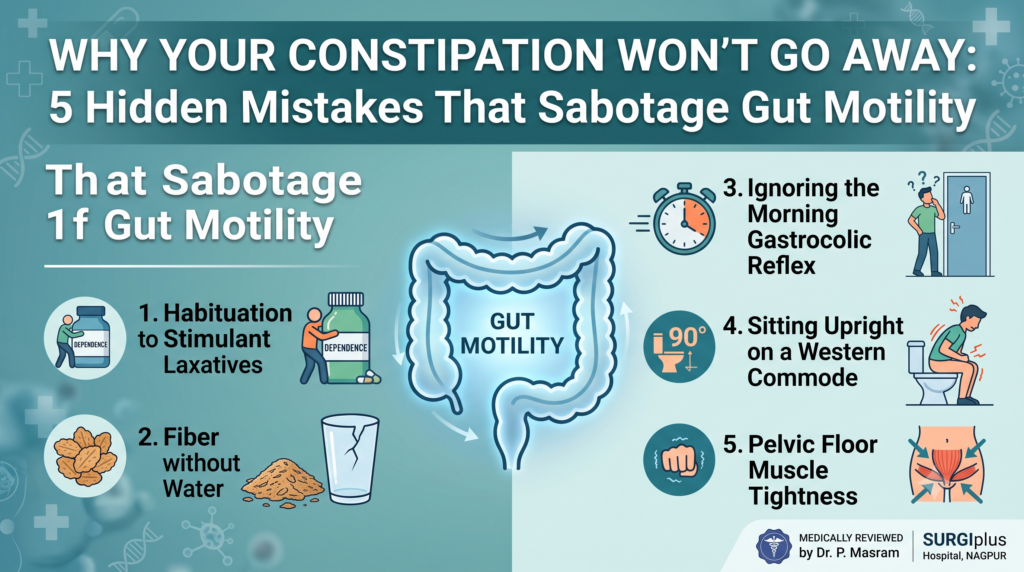
Here are the five most common clinical mistakes that sabotage colonic motility and perpetuate chronic constipation:
1. Habituation to Stimulant Laxatives and Daily Churnas
Many traditional digestive churnas, senna tablets, and herbal cleansing teas rely on stimulant anthraquinones or chemical bowel irritants. While they produce an immediate, watery bowel movement the next morning, they do so by chemically forcing violent contractions of the colonic smooth muscles.
Over months of daily use, the nerve receptors in the intestinal lining (the myenteric plexus) lose their natural sensitivity to fecal bulk. The colon becomes physically dependent on artificial stimulation to produce peristalsis—a condition known clinically as “cathartic colon” or lazy bowel syndrome. Prolonged use of senna-containing blends can also lead to melanosis coli (pigment deposits lining the colon walls).
The Clinical Fix: Stimulant laxatives should be reserved for short-term, acute relief (not exceeding 7 to 10 days). If your bowel cannot move without a nightly laxative dose, you need a physician-guided transition to osmotic stool softeners or natural soluble bulk formers.
2. Consuming Insoluble Fiber Without Adequate Water
The most common dietary advice given to constipation sufferers is simply “eat more fiber.” However, loading up on raw roughage—such as wheat bran, raw salads, and unpeeled raw vegetables—often backfires dramatically in individuals with slow motility.
Insoluble fiber acts like dense bulking brushwood. If your gut is already sluggish and transit time is slow, adding dense roughage without substantial hydration simply creates a massive, dry fecal bolus that stalls in the sigmoid colon, leading to intense gas, painful distension, and severe impaction.
The Clinical Fix: Prioritize soluble, gel-forming fibers (such as purified Isabgol/psyllium husk, stewed apples, soaked chia seeds, or oats) that absorb water to form a soft, slippery matrix. Crucially: every teaspoon of fiber must be accompanied by at least 250–300 ml of plain water.
3. Suppressing the Morning Gastrocolic Reflex
The human colon exhibits its strongest propulsive contractions (mass peristaltic waves) immediately upon waking and roughly 15 to 30 minutes after eating breakfast. This physiological event is called the gastrocolic reflex.
In modern schedules, people frequently rush out the door, skip breakfast, or delay using the bathroom because they are commuting or working. When you repeatedly ignore or suppress the body’s natural urge to defecate, the rectal vault stretches to accommodate the stool. Over time, rectal sensation blunts, and the urge diminishes entirely—leaving the stool to sit longer in the colon, where more water is reabsorbed, turning it hard and painful to pass.
The Clinical Fix: Harness your natural morning reflex. Drink two glasses of warm water right after waking up, eat a light breakfast, and dedicate 10 undisturbed minutes for bathroom time every morning—without rushing.
4. Sitting Upright at 90 Degrees on Modern Western Commodes
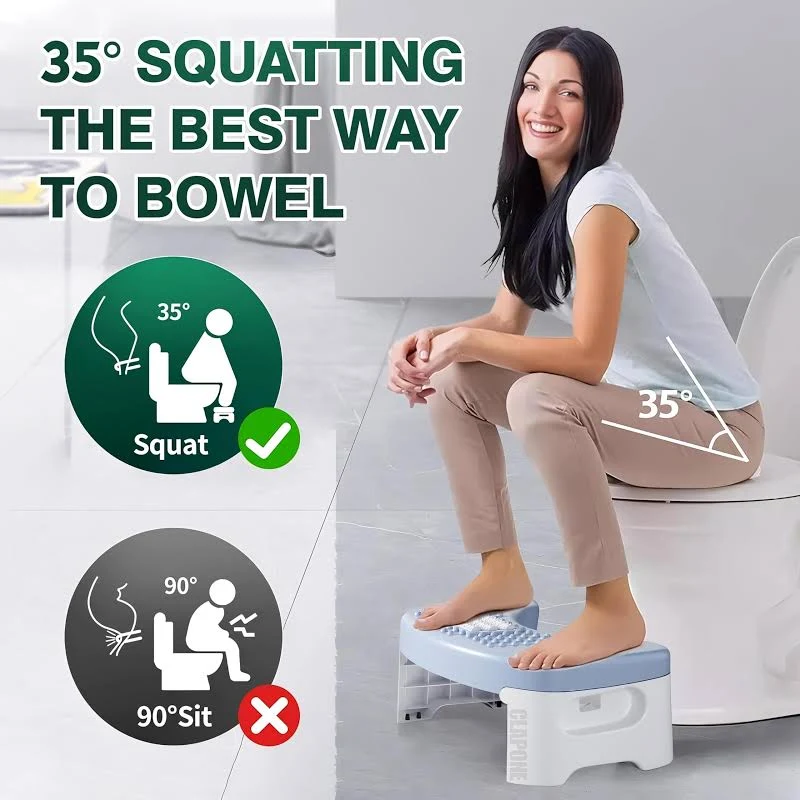
Modern flush commodes were designed for sitting comfort, not for human defecation physiology. When sitting upright with your thighs at a 90-degree angle to your torso, a sling-like muscle in the pelvic floor called the puborectalis muscle remains engaged.
The puborectalis pulls the lower rectum forward, creating a deliberate choke-point (anorectal angle of ~90 degrees) that prevents fecal incontinence during standing or sitting. When trying to pass stool in this upright posture, you are literally forcing stool through a partially constricted kink in the hose, leading to excessive straining, hemorrhoidal engorgement, and mucosal tears.
The Clinical Fix: Recreate a 35-degree squatting posture on your western toilet. Elevate your feet 6 to 8 inches using a purpose-built bathroom step stool. This natural pelvic tilt allows the puborectalis muscle to relax completely, unkinking the rectal canal for effortless evacuation without straining.
5. Pelvic Floor Dyssynergia (Straining Against a Closed Sphincter)
Up to 30% to 40% of people with medically refractory chronic constipation do not have slow transit—they have pelvic floor dyssynergia (sometimes referred to as anismus).
Normally, when you bear down to pass stool, your intra-abdominal pressure rises while your anal sphincter and pelvic floor muscles reflexively relax. In patients with dyssynergia, these muscles paradoxically contract and tighten shut when bearing down. The harder the patient strains, the tighter the sphincter clamps, causing a sensation of incomplete evacuation, rectal fullness, and agonizing post-defecation burning.
The Clinical Fix: Straining forcefully will only trigger anal fissures and worsen hemorrhoids. Warm water sitz baths for 10–15 minutes before or after bowel movements help relieve localized internal sphincter hypertonia. Chronic dyssynergia can also be definitively evaluated using anorectal manometry and retrained through pelvic floor biofeedback therapy.
Disclaimer: This article provides evidence-based health information and practical supportive advice. It is not intended to replace personalized clinical diagnosis or formal surgical evaluation. If you experience persistent rectal bleeding, sudden changes in bowel habits, or severe unexplained abdominal pain, consult a specialist immediately.
FAQ
1. Why does my constipation get worse even after eating more fiber?
Eating high amounts of insoluble roughage (like raw salads and coarse bran) without adequate hydration creates a bulky, dry fecal mass. If you have slow gut motility, this dry stool stalls in the colon, intensifying gas and abdominal pain. Always prioritize soluble fiber and drink at least 250–300 ml of water per serving.
2. Is it safe to use daily digestive churnas or senna tablets?
No. Daily digestive churnas and herbal laxative teas often rely on stimulant ingredients like senna. Regular, prolonged use desensitizes the enteric nerves in the colon wall, creating dependency (“cathartic colon” or lazy bowel syndrome). Stimulant laxatives should only be used as a short-term measure under a doctor’s guidance.
3. How does using a toilet footstool help relieve chronic constipation?
Sitting upright at 90 degrees on a western toilet keeps the puborectalis muscle tightened around the rectum, creating a kink that blocks easy evacuation. Elevating your feet 6 to 8 inches onto a footstool creates a 35-degree squatting posture, which relaxes the muscle and aligns the canal for effortless passage without straining.
4. What is the difference between slow transit motility and pelvic floor dyssynergia?
Slow transit motility means the colon’s muscular contractions are sluggish, delaying stool delivery to the rectum. Pelvic floor dyssynergia (anismus) is a coordination failure where the anal sphincter clenches tightly instead of opening when you strain. While slow motility responds well to hydration and soluble fiber, dyssynergia requires posture correction, sitz baths, or biofeedback therapy.
5. When should chronic constipation be evaluated by a surgical specialist?
You should seek a specialist evaluation immediately if constipation is accompanied by rectal bleeding, unexplained weight loss, pencil-thin stools, severe persistent abdominal pain, or a sudden change in bowel frequency after age 45. These red flags require diagnostic assessment to rule out structural blockages or underlying colorectal pathology.