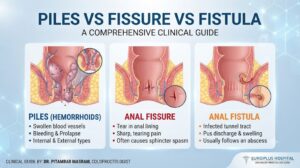
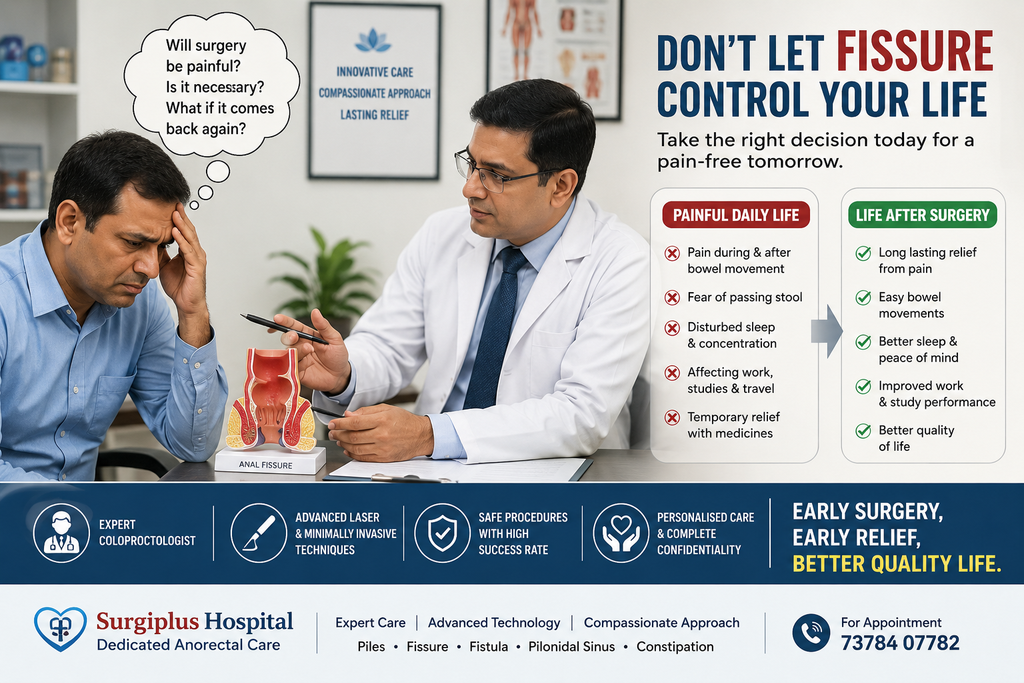
An anal fissure can be extremely painful, especially during and after passing stool. Many patients experience significant relief after using creams, painkillers, stool softeners or medicines prescribed by their doctor. Because the pain improves, they assume that the fissure has completely healed.
But pain relief and fissure healing are not always the same thing.
A fissure may become temporarily painless while the underlying tear is still present. After a few days or months, another hard stool, constipation or straining can reopen the wound, and the severe pain returns.
This is one reason why some patients suffer from recurrent anal fissure for years.
What Is an Anal Fissure?
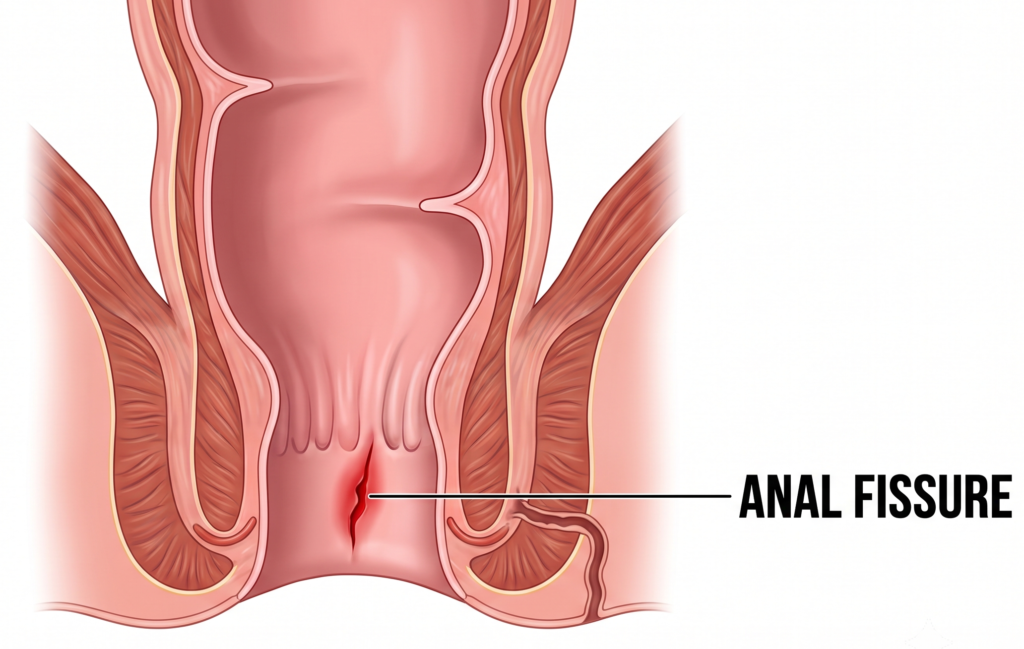
An anal fissure is a small tear or ulcer in the lining of the anal canal. It commonly occurs after passing hard or bulky stool, constipation or repeated trauma during bowel movements.
The typical symptoms are:
- Sharp pain while passing stool
- Burning or severe pain after bowel movement
- Bright-red bleeding
- Fear of passing stool
- Constipation caused by avoiding bowel movements
- Tightness or spasm around the anus
Most newly developed acute anal fissures can heal with appropriate conservative treatment, including keeping stools soft, adequate fibre and fluids, warm sitz baths and appropriate medicines.
The problem begins when the fissure fails to heal and becomes chronic.
Acute Fissure vs Chronic Fissure
An acute fissure is usually a relatively fresh tear. Its edges are generally soft and there may be a good possibility of healing with proper medical treatment.
A chronic anal fissure behaves differently.
With repeated trauma, the fissure can develop thickened or fibrotic edges, a sentinel skin tag and sometimes an exposed internal sphincter muscle at its base. Increased resting pressure and sphincter spasm can further reduce blood flow and make healing difficult.
This creates a vicious cycle:
Pain → sphincter spasm → reduced blood flow → poor healing → persistent fissure → more pain.
That is why simply suppressing the pain may not solve the problem.
Why Does the Pain Disappear But the Fissure Return?
This is a very common situation.
A patient may use an OTC cream or medicine and feel much better within a few days. The patient then stops the treatment and returns to normal activities.
However, if the actual fissure has not healed, the next episode of constipation or hard stool can injure the same area again.
The patient then says:
“Doctor, my fissure had completely healed, but suddenly it has come back.”
In reality, it may have been temporarily symptom-free rather than completely healed.
Therefore, recurrent pain after repeated courses of treatment is an important reason to have the fissure reassessed by a colorectal or general surgeon.
When Should You Consider Surgery for Anal Fissure?
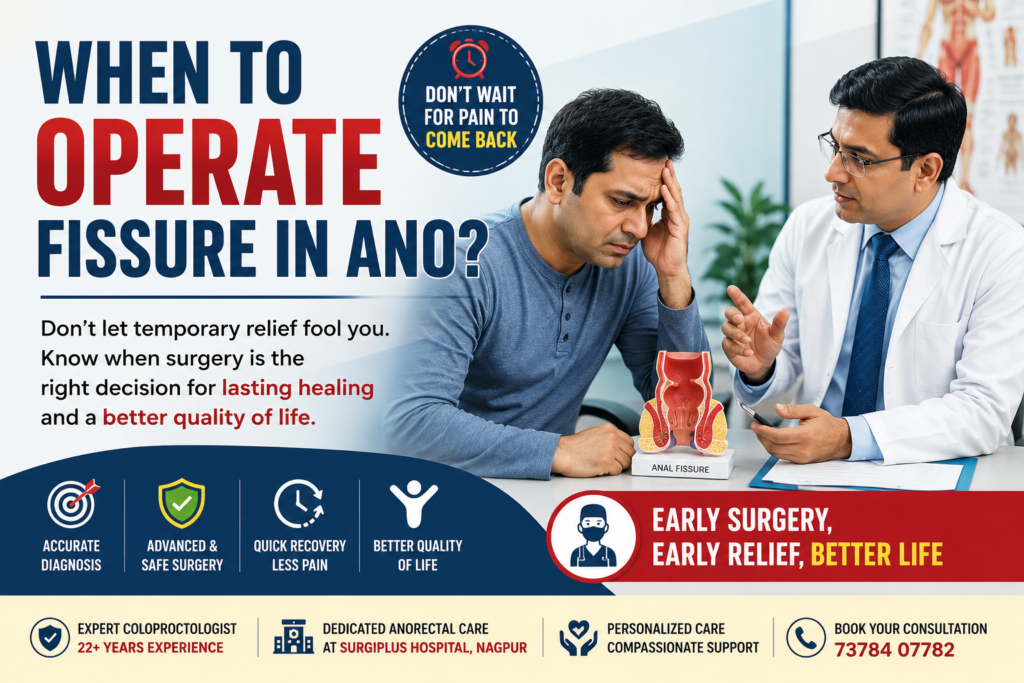
Surgery is generally considered when a fissure is chronic, recurrent or fails to respond adequately to appropriate medical treatment.
A decision about surgery should be made after proper examination rather than simply based on how many days the patient has had pain.
Important situations include:
1. The fissure keeps coming back
If you have repeated episodes of fissure pain every few weeks or months despite appropriate treatment, it is worth asking whether the fissure has actually healed.
Repeated recurrence may indicate persistent sphincter spasm or a chronic fissure.
2. The fissure has become chronic
A fissure that persists for several weeks and develops features of chronicity may require more definitive treatment.
Chronic fissures can have fibrosis, thickened edges, sentinel skin tags and exposed internal sphincter fibres.
Not every chronic fissure automatically requires surgery—some can still respond to properly prescribed medical therapy—but the likelihood of needing a procedure increases when conservative treatment repeatedly fails.
3. You have already tried proper medical treatment without lasting healing
If you have used appropriate stool-softening measures and prescribed fissure medicines for an adequate period but the fissure continues to cause symptoms, continuing the same treatment indefinitely may not be the best strategy.
Your surgeon may discuss options such as botulinum toxin or surgery depending on the individual case.
4. You are a student preparing for important examinations
This is an often-overlooked reason to consider earlier definitive treatment.
Imagine preparing for a competitive examination while experiencing severe pain every time you pass stool. The pain may continue for hours after bowel movement. You may spend time worrying about the next toilet visit instead of studying.
If your fissure is repeatedly disturbing your sleep, concentration, sitting time or study schedule, discuss definitive treatment with your surgeon well before your examination, rather than waiting until the examination period.
The goal is not that every student must undergo surgery. The goal is to avoid allowing a recurrent fissure to become a major interruption during an important academic period.
5. Your job requires prolonged travelling or riding a motorcycle
People who spend many hours travelling, riding a bike, driving or working outside may find recurrent fissure particularly difficult to manage.
Frequent bowel-related pain, urgency, difficulty finding a comfortable toilet and prolonged sitting can interfere substantially with work.
If medical treatment repeatedly gives only temporary relief, a surgeon can assess whether definitive treatment would be appropriate.
6. Your work requires continuous concentration
Professionals such as salespersons, marketers, field workers, teachers, doctors and business owners may not be able to stop working whenever fissure pain occurs.
If recurrent fissure is affecting your productivity, sleep, concentration or ability to travel, it is reasonable to discuss whether continued medical treatment or definitive treatment is the better option.
7. You are repeatedly postponing treatment because of temporary relief
This is perhaps the most important point.
Do not use disappearance of pain as the only measure of healing.
If the pain returns repeatedly after stopping medicines, get the fissure examined again.
The question should be:
“Has my fissure actually healed?”
—not merely—
“Is my pain gone?”
What About Housewives?
There is no medical rule that housewives must wait for surgery while working people should undergo surgery immediately.
However, someone whose daily responsibilities allow enough flexibility may have more opportunity to try a properly supervised medical treatment, improve bowel habits and observe whether the fissure genuinely heals.
If it does not heal or repeatedly returns, surgery should not be postponed indefinitely simply because the pain temporarily improves.
The correct decision depends on the fissure, its chronicity, previous treatment and the patient’s circumstances, not occupation alone.
To watch complete playlist of fissure, click here
What About Diabetes?
Patients with diabetes should not ignore a persistent anal fissure.
Poorly controlled diabetes can impair wound healing and increase susceptibility to infections. Therefore, a diabetic patient with persistent severe pain, swelling, fever, pus discharge or increasing redness around the anus should seek medical assessment promptly.
However, diabetes by itself does not mean that every anal fissure must be operated immediately.
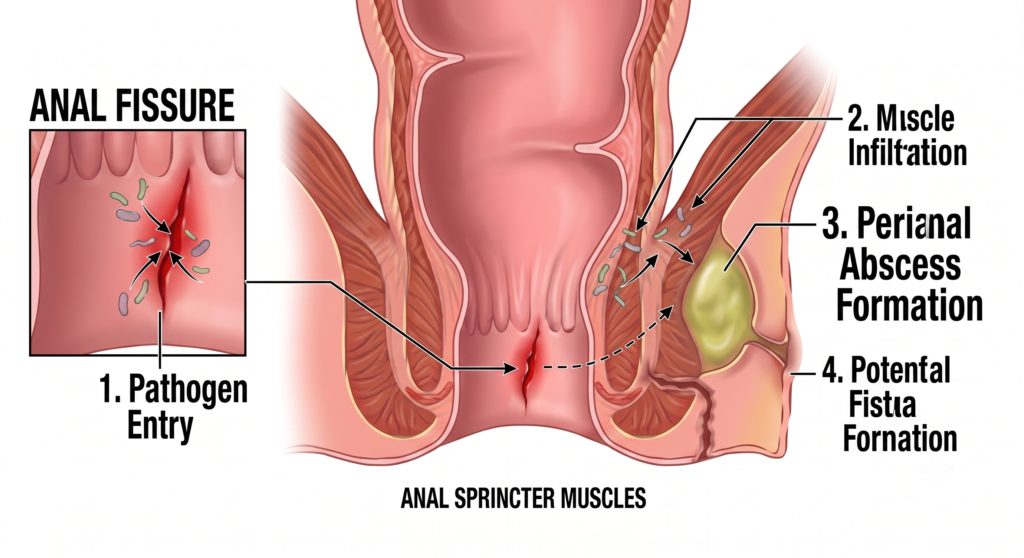
If there is a suspected perianal abscess, that is a different problem requiring urgent surgical evaluation.
Do not assume that every painful fissure is an abscess.
Can an Anal Fissure Cause an Abscess?
An anal fissure is primarily a tear in the anal lining and is not the same disease as a perianal abscess.
If a patient develops increasing swelling, constant throbbing pain, fever, pus discharge or a tender lump, an abscess should be considered and examined urgently.
Patients with diabetes or other conditions that impair immunity should be particularly cautious about persistent or worsening symptoms.
{If you want a Free Fissure guidance from us, please click the below link of our official Instagram account, watch any reel and comment as ‘Fissure’ and send. You will get a DM where there will be a link to download our free E-book.}
https://www.instagram.com/reel/DcgNdITMSQM/?igsi=MWNybXhham8xZHRrcw==
What Is Fissure Laser Surgery?
Fissure laser surgery is a term commonly used by some centres to describe minimally invasive laser-assisted treatment of anal fissure.
Patients should understand that “laser” describes the technology or technique being used; it does not automatically mean that every laser procedure is the same.
For chronic anal fissure, the surgeon must address the underlying mechanism responsible for failure to heal—often excessive internal sphincter pressure—while choosing a technique appropriate for the individual patient.
One established surgical treatment for chronic fissure is lateral internal sphincterotomy, which reduces excessive internal sphincter pressure and has a high healing rate in appropriately selected patients.
Therefore, before choosing fissure laser surgery, ask your surgeon:
- What exactly will be done?
- Is the internal sphincter being treated?
- Is the fissure chronic?
- Are there alternative medical treatments?
- What are the expected benefits and risks?
- What is the surgeon’s experience with the procedure?
When Surgery May Be a Better Choice
A practical way to think about it is this:
Acute fissure + first episode + improving with proper treatment → medical treatment may be appropriate.
Persistent or recurrent fissure + repeated treatment failures → surgical assessment should be considered.
Chronic fissure + significant symptoms + failure of appropriate medical treatment → definitive treatment may be appropriate.
Severe or worsening symptoms, swelling, fever or pus → prompt examination is important.
The exact treatment should always be individualized.
Don’t Wait Until the Fissure Controls Your Life
Many people tolerate anal fissure pain for months because the pain disappears temporarily after applying a cream.
But if the same problem repeatedly returns, don’t keep treating only the symptom.
A proper examination can determine whether you have:
- A fresh acute fissure
- A chronic fissure
- A recurrent fissure
- Hemorrhoids along with fissure
- A fistula or abscess
- Another condition that looks like a fissure
Fissures in unusual positions, particularly lateral or multiple fissures, may require evaluation for underlying conditions rather than simply treating them as an ordinary fissure.
Final Message
The right time for fissure surgery is not determined only by how severe the pain is today.
A patient may have severe pain but an acute fissure that can heal with proper treatment. Another patient may have relatively little pain today but a chronic, repeatedly recurring fissure that needs definitive treatment.
Therefore, if your fissure pain keeps returning despite medicines and creams, do not simply wait for the next painful episode.
Get the fissure examined and find out whether it has actually healed.
For students, frequent travellers, field workers and professionals whose recurrent fissure is interfering with daily life, an early discussion with a surgeon can help plan treatment at a convenient time rather than allowing the problem to interfere with work or examinations.
And if you are considering fissure laser surgery, discuss the exact technique, expected healing, risks and alternatives with an experienced colorectal or general surgeon before making your decision.
Remember: relief from pain is not always proof of healing. The real goal is complete and lasting healing of the fissure.
Expert Opinion: When Should You Consider Surgery for Anal Fissure?
Dr. Pitambar Masram, MBBS, MS, FISCP – Coloproctologist, Nagpur
“In my practice, I frequently see patients who have been suffering from fissure pain for months or even years. Many of them have taken different creams, painkillers and medicines whenever the pain became severe. The pain improved temporarily, so they assumed that the fissure had healed. Unfortunately, the same pain returned again after some time.”
As a surgeon specialising in coloproctology and anorectal diseases, I believe that the most important question is not simply whether the pain has stopped, but whether the fissure has actually healed.
A newly developed anal fissure can often be treated successfully with appropriate medical treatment, correction of constipation, stool-softening measures and medicines prescribed by a doctor. Surgery should not be the first treatment for every patient.
However, when a fissure becomes chronic, repeatedly recurs, or fails to heal despite appropriate medical treatment, continuing to use the same cream again and again may only provide temporary relief.
At this stage, I recommend a proper surgical evaluation to understand why the fissure is not healing and whether a definitive procedure would provide a better long-term solution.
I also advise patients to consider their personal and professional circumstances. A student preparing for an important examination, a person whose occupation involves extensive travelling or motorcycle riding, or someone whose recurrent fissure is seriously affecting sleep, concentration and work may benefit from discussing definitive treatment earlier rather than allowing the condition to repeatedly interfere with daily life.
At Surgiplus Hospital, Koradi, Nagpur, we provide specialised care for anorectal conditions including piles, fissure, fistula and pilonidal sinus. The hospital was developed to provide dedicated anorectal care along with modern surgical facilities and personalised postoperative support.
I have been practising surgery for more than two decades, with specialised training in coloproctology (FISCP), and have extensive experience managing fissure, piles, fistula and other anorectal conditions.
My advice to patients with fissure
Do not judge the success of treatment only by the disappearance of pain.
If your pain repeatedly disappears with medicines and then returns after a few weeks or months, get the condition examined again. You may have a chronic or recurrent fissure that requires a different treatment approach.
And if surgery is recommended, ask your surgeon about the exact procedure, its benefits, possible complications, expected recovery and whether there are suitable non-surgical alternatives for your particular case.
The aim should always be lasting healing—not simply temporary suppression of pain.
Dr. Pitambar Masram, MBBS, MS, FISCP
Coloproctologist & Anorectal Surgeon
Surgiplus Hospital, Koradi, Nagpur
Frequently Asked Questions About Anal Fissure Surgery
1. How do I know if my anal fissure needs surgery?
Surgery may be considered when an anal fissure becomes chronic, repeatedly comes back, or does not heal despite appropriate medical treatment. Persistent pain, recurrent bleeding, a sentinel skin tag or a fissure that has been present for a long time should be evaluated by a surgeon. Not every fissure requires surgery, so proper examination is important.
2. Can a chronic anal fissure heal without surgery?
Yes, some chronic fissures can improve with appropriate medical treatment. However, chronic fissures are generally more difficult to heal than acute fissures. If symptoms continue or repeatedly return despite proper treatment, your surgeon may recommend a procedure such as botulinum toxin treatment or surgery depending on your condition.
3. Does pain relieved means fissure healed?
Not necessarily. Pain can temporarily disappear even when the underlying fissure has not completely healed. If pain returns after stopping medicines or after passing a hard stool, the fissure may still be present or may have reopened. A medical examination can help determine whether genuine healing has occurred.
4. Is fissure laser surgery better than conventional fissure surgery?
The word laser does not automatically mean better or safer. Different procedures use different techniques, and the appropriate treatment depends on the type and chronicity of the fissure, sphincter pressure, previous treatment and individual risk factors. Ask your surgeon exactly what procedure is being proposed, how it works and what its potential benefits and risks are.
5. How long should I wait before considering surgery for a fissure?
There is no single waiting period that is suitable for everyone. A first-time acute fissure may be given an appropriate trial of medical treatment. However, if the fissure is persistent, recurrent or significantly affecting your sleep, studies, work, travelling or quality of life, you should have it reassessed rather than repeatedly relying on temporary pain relief. Your surgeon can then decide whether continuing medical treatment or definitive treatment is appropriate.