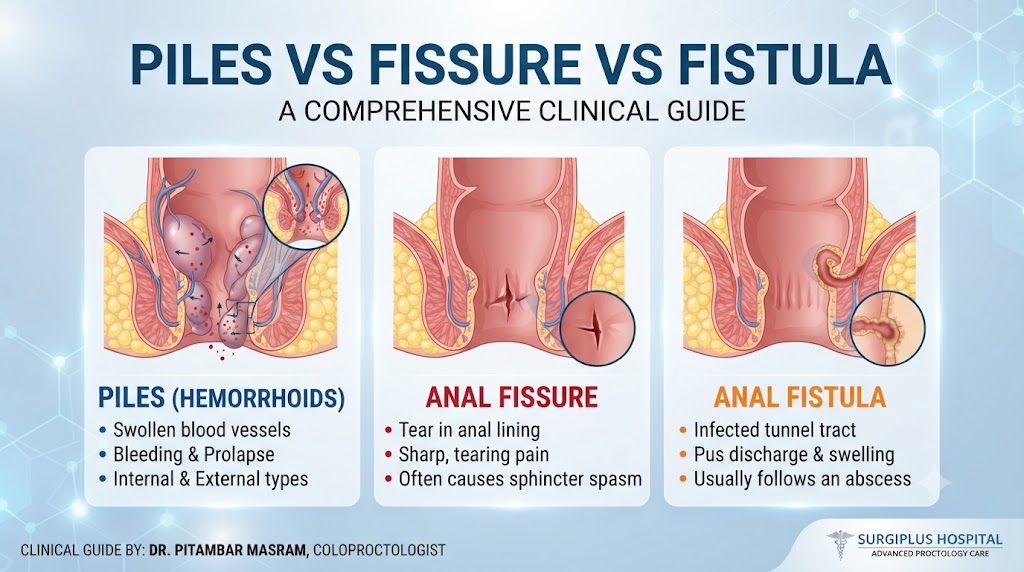
Perianal discomfort and rectal symptoms are among the most frequently encountered yet heavily misunderstood medical complaints. Because symptoms like bleeding, swelling, and pain frequently overlap, patients often use the term “piles” as an umbrella term for any anal issue. However, understanding piles vs fissure vs fistula is essential because these three conditions are entirely distinct clinical entities with unique pathological causes, symptoms, and surgical interventions.
Getting an accurate diagnosis starts with recognizing how piles vs fissure vs fistula differ in presentation and progression.
Difference Between Piles and Fissure
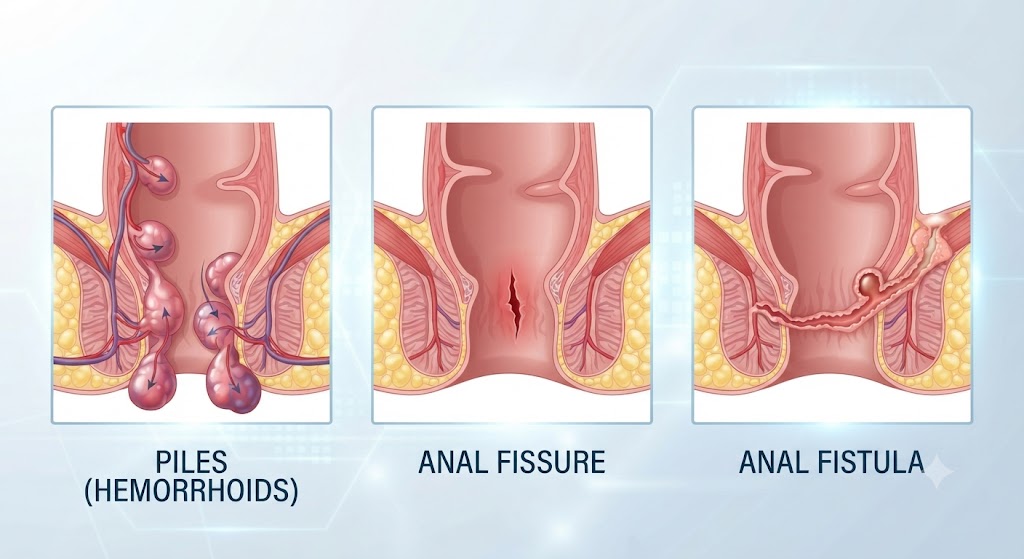
When evaluating piles vs fissure vs fistula, patients often confuse piles and fissures because both are linked to bowel movements. However, their underlying structures differ significantly:
| Feature | Piles (Hemorrhoids) | Anal Fissure |
| Definition | Swollen, engorged blood vessels located inside or outside the anal canal. | A small tear or linear crack in the delicate skin lining (anoderm) of the anal canal. |
| Primary Cause | Increased venous pressure driven by chronic constipation, heavy straining, or pregnancy. | Passage of hard, dry stools, mechanical trauma, or high resting anal sphincter pressure. |
| Pain Profile | Generally painless during bowel movements; primary symptom is bright red bleeding or a prolapsing lump. | Excruciating, sharp, tearing pain during and significantly after bowel movements, lasting for hours. |
| Bleeding | Bright red blood coating the stool or dripping into the toilet bowl, typically painless. | Minimal bright red blood, usually seen as streaks on toilet paper or on the outer surface of hard stool. |
| Physical Sign | Soft, fleshy vascular lumps or tissue prolapsing outside the anus. | A visible linear skin crack, often accompanied by a “sentinel pile” skin tag at the lower end. |
Difference Between Piles and Fistula
Another critical comparison when studying piles vs fissure vs fistula is examining how vascular cushions contrast with deep-seated infections:
| Feature | Piles (Hemorrhoids) | Anal Fistula |
| Definition | Enlarged vascular cushions within the anal canal. | An abnormal, infected tunnel or tract connecting the interior of the anal canal to the perianal skin. |
| Underlying Issue | Vascular congestion and laxity of supporting submucosal connective tissue. | A previous perianal abscess that failed to heal completely, leaving an open epithelialized channel. |
| Discharge | Fresh bleeding is typical; mucus discharge may occur if tissue prolapses. | Persistent foul-smelling, pus-filled, or serous discharge that constantly stains undergarments. |
| Swelling & Pain | Painless unless thrombosed (where a blood clot causes acute, severe ischemic pain). | Recurrent painful swelling, throbbing deep discomfort, and chronic skin irritation around an external opening. |
| Natural History | Can fluctuate in grades (I to IV) and may spontaneously reduce or require manual push-back. | Never heals on its own; almost always requires definitive surgical intervention to eradicate the tract. |
Difference Between Fissure and Fistula
To fully master the subject of piles vs fissure vs fistula, it is vital to understand how a surface tear transitions into a deep channel:
| Feature | Anal Fissure | Anal Fistula |
| Nature of Lesion | A superficial surface tear or ulceration of the anal skin lining. | A deep-seated hollow tract running through the perianal tissues and sphincter muscle complex. |
| Pain Mechanism | Spasm of the internal anal sphincter triggered by mechanical tearing during defecation. | Pressure buildup from localized infection and abscess formation prior to spontaneous or surgical drainage. |
| External Presentation | A superficial crack; sometimes accompanied by a fibrous sentinel skin tag. | One or more chronic external openings (pimples or holes) leaking pus, blood, or fluid onto the skin. |
| Chronicity | Can be acute (healing in weeks with conservative therapy) or chronic (persisting beyond 6 weeks). | Inherently chronic and progressive; marked by recurring cycles of abscess formation and drainage. |
Which Comes First: Piles, Fissure, or Fistula?
While analyzing piles vs fissure vs fistula, patients often wonder how these conditions relate sequentially. Although they can develop independently, they are frequently linked in a progressive pathological chain reaction driven by chronic constipation:
- The Root Cause (Constipation): Straining to pass hard, dry stools increases intra-abdominal and anal pressure.
- First Stage (Piles or Fissure): The constant pressure forces vascular cushions to dilate (piles) or stretches the anal lining beyond its limit, creating a tear (fissure).
- Second Stage (The Spasm Cycle): A chronic fissure causes the internal anal sphincter muscle to go into spasm. This muscle spasm cuts off adequate blood flow, preventing the tear from healing.
- Third Stage (Fistula Development): If bacteria enter the unhealed fissure or an obstructed anal gland, it leads to a painful anal abscess. Once that abscess drains or bursts, the residual tunnel becomes a chronic anal fistula.
Thus, addressing piles vs fissure vs fistula early—starting with lifestyle and dietary corrections—prevents this cascade from turning into a severe surgical problem.
Surgical Treatments for All Three
When conservative measures (high-fiber diets, adequate hydration, sitz baths, and specialized ointments) fail, modern proctology offers precise, low-pain, and rapid-recovery surgical options for piles vs fissure vs fistula:
- Surgical Treatment for Piles:
- Laser Hemorrhoidoplasty (LHP): Laser energy delivered via a fine fiber probe shrinks hemorrhoidal tissue from within without cutting or excising skin.
- Stapled Hemorrhoidopexy (PPH): A circular stapler repositions prolapsed tissue back anatomically and cuts off its blood supply.
- Conventional Excisional Hemorrhoidectomy: Traditional surgical removal reserved for severe grade III or IV prolapsed piles.
- Surgical Treatment for Fissures:
- Lateral Internal Sphincterotomy (LIS): The gold-standard minor surgery where a tiny section of the internal anal sphincter muscle is released, permanently stopping muscle spasm and allowing rapid fissure healing.
- Botox Injection: Chemical denervation of the sphincter muscle as a temporary, non-surgical alternative to relax muscle spasms.
- Surgical Treatment for Fistulas:
- FiLaT (Fistula-tract Laser Closure): A sphincter-saving procedure using a radial laser fiber to ablate and close the fistula tract internally.
- LIFT (Ligation of Intersphincteric Fistula Tract): Accessing the tract between sphincter muscles to tie and divide it, preserving complete muscle continence.
- VAAFT (Video-Assisted Anal Fistula Treatment): Diagnostic endoscopy of the fistula tract followed by precise electrocauterization under direct vision.
Indications to Operate in All These 3
Knowing when to transition from medical management to surgery is a vital part of understanding piles vs fissure vs fistula:
- Indications for Piles Surgery:
- Grade III and IV prolapsed piles that cannot be reduced manually.
- Persistent, heavy bleeding leading to chronic anemia or weakness.
- Thrombosed piles causing severe, unbearable ischemic pain.
- Failure of conservative lifestyle modifications or rubber band ligation.
- Indications for Fissure Surgery:
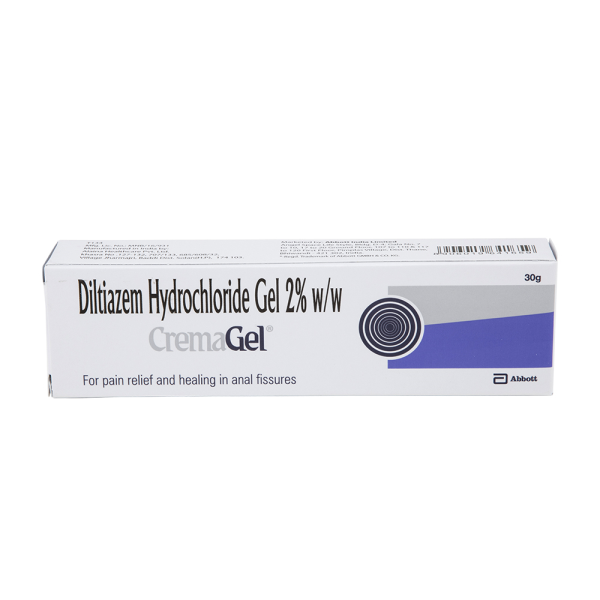
- Chronic anal fissure persisting longer than 6 weeks despite medical management (such as calcium channel blocker or nitroglycerin creams).
- Presence of fibrosed edges, hypertrophied anal papillae, or a sentinel pile.
- Debilitating, intractable pain cycles that drastically degrade daily quality of life.
- Indications for Fistula Surgery:
- Virtually all true established anal fistulas require surgery, as spontaneous closure is extremely rare.
- Recurrent perianal abscesses continuously discharging pus, blood, or foul fluid.
- Systemic signs of infection, fever, or spreading perianal sepsis.
AnoSpray Advanced Piles and Fissure pain relief spray
This post Medically reviewed by
This clinical guide regarding piles vs fissure vs fistula was authored by Dr Pitambar Masram, MS, FISCP, CUSG, an expert physician, surgeon, and coloproctologist practicing at SurgiPlus Hospital, located near Vanjari Bhavan in Koradi, Nagpur, Maharashtra, India. Dedicated to advanced, compassionate care, Dr. Masram specializes in modern minimally invasive and laser proctology treatments for patients across the Nagpur and Vidarbha regions.
[FAQ] Frequently Asked Questions
1. Can piles automatically turn into a fistula?
No, piles (swollen veins) and fistulas (infected tunnels) have entirely different structures. However, neglected proctological conditions or secondary bacterial infections can lead to an abscess, which may subsequently result in an anal fistula.
3. Why does an anal fissure hurt so much more than piles?
The anoderm is densely packed with somatic pain receptors, making it intensely sensitive, whereas internal hemorrhoids sit above the dentate line where pain fiber density is low. Furthermore, a fissure triggers intense sphincter muscle spasms every time you pass stool.
4. Can lifestyle changes completely cure a fistula?
No. While a high-fiber diet, hydration, and sitz baths help manage early symptoms of piles and fissures, an established anal fistula features an epithelialized bacterial tract that strictly requires surgical closure or drainage to heal.
5. When should I consult a proctologist instead of waiting?
5. When should I consult a proctologist instead of waiting? You should seek professional medical evaluation immediately if you experience persistent rectal bleeding, severe pain during bowel movements, a recurring lump near the anus, or ongoing foul-smelling pus discharge that fails to resolve within a few days.
If you are finding out Dedicated hospital for piles fissure fistula, then Click Here