
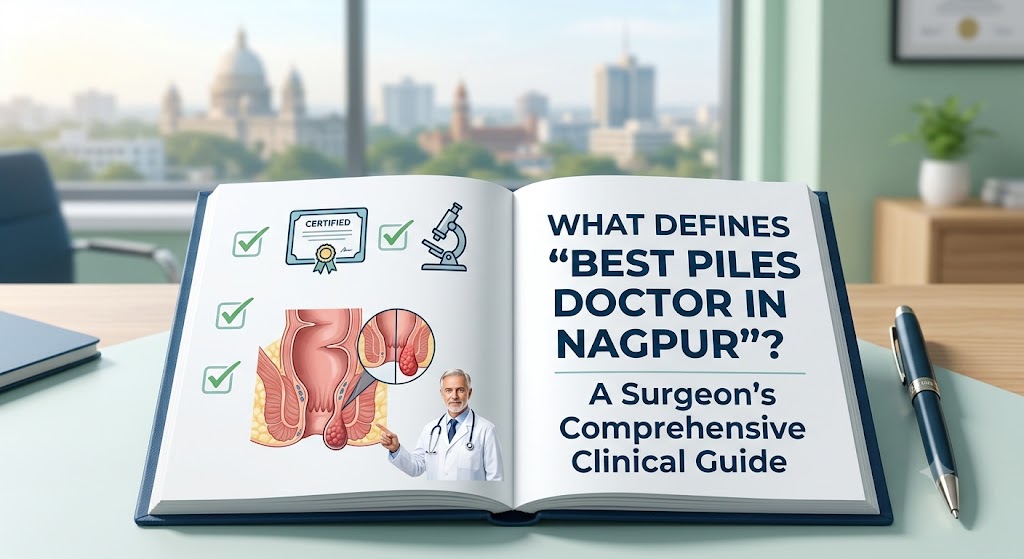
The phrase “Best Piles Doctor in Nagpur” is one of the most frequently searched medical queries across Central India. However, true clinical mastery in proctology cannot be determined by billboard advertisements, search engine marketing, or commercial claims.
Anorectal diseases involve an exceptionally complex, vascular, and nerve-dense region of human anatomy. Operating on the anal canal requires millimeter-level precision, an exhaustive grasp of pelvic floor mechanics, and the diagnostic acumen to separate benign hemorrhoidal cushions from aggressive malignancies.
When evaluating what genuinely elevates a surgical specialist to the highest standard of anorectal care, patients and referring practitioners must look beyond commercial visibility and evaluate strict, objective clinical criteria.
1. Registered Allopathy Surgical Foundation (MBBS, MS General Surgery)
The core pillar of legitimate anorectal healthcare begins with formal, regulated modern medicine (Allopathy). The specialist must hold an undergraduate degree in medicine (MBBS) followed by a formal, full-time Master of Surgery (MS) in General Surgery from an institution accredited by the National Medical Commission (NMC) and registered with the State Medical Council.
A thorough allopathic surgical foundation guarantees that the surgeon understands systemic human physiology, pharmacokinetics, fluid-electrolyte balance, surgical microbiology, and evidence-based wound healing. Hemorrhoids are not isolated anatomical anomalies; they are vascular cushions linked to systemic venous hemodynamics, portal circulation, and pelvic floor dynamics. Entrusting anorectal interventions to practitioners without formal surgical degrees or to unregulated alternative practitioners carries severe risks of irreversible tissue damage, uncontrolled hemorrhage, and delayed identification of serious pathology.
Clinical Note: Always verify that your treating surgeon displays a valid State Medical Council registration number with postgraduate surgical credentials (MS in General Surgery), ensuring strict adherence to modern surgical standards and ethical medical practice.
Read more about Dr Pitambar Masram, A senior coloproctologist in nagpur
2. Super-Specialized Fellowship Training in Coloproctology
General surgery covers a vast spectrum of abdominal, endocrine, and trauma procedures, but piles and pelvic floor disorders have evolved into a distinct surgical sub-discipline. The best piles specialist holds formal super-specialized fellowship credentials in Coloproctology (such as FISCP—Fellow of the International Society of Coloproctology, FAIS, or equivalent accredited colorectal fellowships).
Super-specialization ensures that the surgeon has dedicated years to mastering the micro-anatomy of the pelvic floor, the delicate internal and external anal sphincters, the puborectalis muscle sling, and the complex anorectal spaces. This advanced training emphasizes sphincter-sparing techniques, ensuring that procedures resolve vascular engorgement without jeopardizing fecal continence, resting tone, or natural defecatory reflexes.
Clinical Note: Fellowship training signifies that the surgeon adheres to internationally benchmarked, sphincter-preserving treatment algorithms designed to minimize recurrence and avoid fecal incontinence.
3. Over 20 Years of Dedicated Clinical and Operative Experience
Surgical judgment in anorectal disorders cannot be learned overnight; it is forged across decades of direct clinical exposure. A surgical specialist with over twenty years of active practice has evaluated thousands of varied presentations, ranging from simple early-stage bleeding piles to complicated, distorted, recurrent anorectal anatomy resulting from previous failed interventions.
This extensive clinical maturity gives the surgeon sharp diagnostic intuition and calm, precise decision-making during intraoperative anomalies. Decades of surgical practice drastically lower intraoperative trauma, reduce anesthesia time, shorten recovery periods, and prevent over-treatment. An experienced surgeon knows not only when and how to operate, but also when not to operate, guiding early cases toward successful conservative recovery.
4. High-Definition Digital Proctovideoscopy for In-House Diagnostics
Relying purely on a blind digital rectal examination or a standard metal proctoscope through a narrow viewing slot leaves significant room for diagnostic error. A premier coloproctology center is equipped with high-definition digital proctovideoscopy right within the consultation suite.
Proctovideoscopy utilizes a specialized optical camera with cold LED illumination to project a high-magnification view of the anal canal, dentate line, and lower rectal mucosa onto an HD medical monitor in real time. This technology eliminates guesswork, allowing the surgeon to assess exact hemorrhoidal grading (Grade I to IV), identify micro-fissures, detect cryptitis, and inspect secondary mucosal changes. Most importantly, it introduces visual transparency into patient counseling: patients can see their pathology firsthand, understand the rationale for the recommended treatment, and observe visual proof of tissue healing during postoperative follow-up visits.
Clinical Note: Transparent healthcare involves showing the patient their disease pathology. High-definition proctovideoscopy bridges the communication gap, allowing patients to observe their baseline condition and track post-treatment recovery objectively.
5. Mastery of Pelvic MRI Fistulogram Reading at the Bedside
Perianal fistulas are frequently misdiagnosed as simple piles or minor perianal boils, leading to inadequate incomplete drainage and disastrous recurrences. A master coloproctologist does not rely solely on the written impression paragraph of an external radiologist’s report; they have mastered the direct interpretation of cross-sectional pelvic MRI Fistulogram sequences.
The surgeon must be able to load the DICOM scan files onto a consultation display monitor, analyze the T2-weighted and STIR imaging sequences slice by slice, and trace the primary fistulous tract, secondary branched extensions, internal opening, suprasphincteric extensions, and relation to the levator ani and external sphincter muscles. Being able to explain this anatomical blueprint directly to the patient over the monitor establishes clarity before entering the operating theatre, ensuring a targeted procedure that eliminates the tract while safeguarding bowel continence.
Clinical Note: A surgical procedure for a complex fistula should never be planned based solely on surface palpation. Direct examination of MRI sequences by the operating surgeon is the global gold standard for complex anorectal tract mapping.
Read about Fissure in ano in details
6. Diagnostic Acumen: Distinguishing Piles from Critical “Piles Mimics”
One of the greatest dangers in anorectal practice is the assumption that every perianal symptom—such as bleeding per rectum, pain, or a palpable lump—is caused by piles. A top coloproctologist possesses the diagnostic vigilance to differentiate benign hemorrhoids from serious or life-threatening mimics:
- Colorectal and Anal Canal Carcinoma: Adenocarcinomas of the rectum or squamous cell carcinomas of the anal canal frequently present with painless rectal bleeding or a sensation of incomplete evacuation, mirroring piles. Tragically, patients are often treated empirically with laxatives or ointments for months, delaying life-saving oncological intervention.
- Solitary Rectal Ulcer Syndrome (SRUS): An uncommon mucosal disorder caused by paradoxical pelvic floor contraction, presenting with bleeding, persistent tenesmus, and excessive straining that can be easily mistaken for prolapsed hemorrhoidal mucosa.
- Inflammatory Bowel Disease (Proctitis & Ulcerative Colitis): Active mucosal inflammation, friability, ulcerations, and blood-streaked stools that require targeted medical gastroenterology treatment rather than surgical resection.
- Anal Warts (Condylomata Acuminata) & Rectal Polyps: Distinct epithelial and mucosal lesions that require histological evaluation, biopsy, or snare polypectomy rather than conventional hemorrhoid therapies.
A skilled proctologist never rushes into a hemorrhoid procedure without first conducting a thorough visual and digital inspection to completely rule out these mimicking conditions.

7. Expert Prevention and Reconstructive Management of Anal Stenosis
Surgical excellence is demonstrated not only during standard procedures, but also in how complications are prevented and repaired. An aggressive or improperly executed hemorrhoidectomy—where excessive amounts of healthy anal skin (anoderm) are removed—leads to severe anal stenosis (dense cicatricial fibrosis and progressive narrowing of the anal canal). Patients with anal stenosis suffer from excruciating defecation, severe tearing, bleeding, and pencil-thin stools.
A master anorectal surgeon understands the biological necessity of preserving healthy squamous skin bridges between excised hemorrhoidal complexes to prevent strictures altogether. Furthermore, should a patient present with iatrogenic anal stenosis caused by an aggressive prior procedure elsewhere, the surgeon must possess the specialized reconstructive skill to perform anoplasty (advancement flaps, such as house, V-Y, or diamond flaps) to reconstruct a functional, painless, and anatomically supple anal opening.
Clinical Note: Anal stenosis is an entirely preventable surgical complication when proper tissue preservation techniques are respected. Reconstructive anoplasty requires advanced coloproctological training to restore normal lumen diameter.
8. Immediate Clinical Recognition and Protocols for Sepsis and Septicemia
While the majority of elective anorectal procedures carry low systemic risk, the anorectum is surrounded by vascular networks and deep, potential tissue spaces (such as the ischiorectal, retrorectal, and pelvirectal spaces) containing abundant bacterial flora. In rare situations—or following undiagnosed deep abscesses—infection can spread rapidly into necrotizing fasciitis (such as Fournier’s gangrene) or enter the bloodstream, resulting in bacteremia, systemic inflammatory response syndrome (SIRS), and fulminant septicemia.
The best piles surgeon maintains high clinical vigilance for warning signs, including persistent tachycardia, disproportionate pelvic pain, high-grade fever, unexplained urinary retention, or altered leukocyte counts. They maintain immediate institutional protocols: rapid hemodynamic stabilization, initiation of targeted broad-spectrum intravenous antimicrobials, and urgent, aggressive surgical debridement or unroofing of deep hidden collections to arrest systemic infection before it becomes life-threatening.
9. Dedicated Surgical Infrastructure and Specially Trained Nursing Staff
Advanced coloproctology cannot be safely conducted in a generic multipurpose day room or makeshift clinical setting. A premier piles center maintains an operating theatre specifically tailored for pelvic floor surgery:
- Specialized Operating Tables: Ergonomic lithotomy and Jack-Knife positioning tables designed to provide optimal pelvic exposure while preventing neurovascular compression in the patient’s legs during surgery.
- Advanced Energy Platforms: Availability of specialized diode laser generators with dedicated radial fibers for Laser Hemorrhoidoplasty (LHP), ultrasonic shears (Harmonic scalpel), and radiofrequency ablation equipment.
- Specialized Pelvic Lighting and Retraction: High-lumen cold surgical lighting, specialized Parks and Eisenhammer retractors, and micro-instruments designed specifically for the narrow confines of the anal canal.
- Specialized Anorectal Nursing Care: Nursing staff must be specifically trained in post-defecation hygiene protocols, painless perineal dressings, sitz bath supervision, and early detection of postoperative urinary retention or secondary bleeding.
Clinical Note: Patient outcomes depend as much on postoperative wound hygiene, dressings, and nursing care as on the procedure itself. A dedicated anorectal care team ensures a smooth, infection-free recovery.
10. Personalized, Sphincter-Preserving Laser & Minimally Invasive Versatility
A hallmark of an exceptional surgeon is the refusal to adopt a “one-size-fits-all” approach. They do not recommend surgery to every patient who walks into the clinic, nor do they force every case into a single surgical technique simply because they own the equipment.
The best specialist maintains a comprehensive armamentarium of conservative, medical, and operative options. For early Grade I and II piles, they prioritize high-fiber dietary restructuring, water intake optimization, pelvic floor biofeedback, and medical venous tonics. When intervention is truly indicated, they offer modern, sphincter-sparing procedures tailored to the patient’s individual anatomy and lifestyle:
- Laser Hemorrhoidoplasty (LHP): Precisely delivers controlled laser energy into the submucosal hemorrhoidal cushion through a tiny puncture, shrinking the vascular node without mucosal cutting, open wounds, or disruption of the anal sphincter.
- Doppler-Guided Transanal Hemorrhoidal Dearterialization (DG-THD): Pinpoints and ligates the terminal branches of the superior rectal artery under ultrasound guidance to stop the blood supply to the piles.
- Stapled Hemorrhoidopexy & Open/Closed Hemorrhoidectomy: Reserved selectively for massive, fibrotic, non-reducible Grade IV prolapses where laser shrinkage alone is insufficient to address extensive redundant tissue.
By tailoring the procedure to the exact anatomical grade, age, continence profile, and occupational demands of the patient, the surgeon achieves long-term symptom relief with minimal pain, minimal hospital downtime, and zero compromise to lifelong continence.
About the Author & Clinical Director
Dr Pitambar Masram (MBBS, MS, FISCP, CUSG) is a senior consultant coloproctologist, laparoscopic surgeon, and pelvic floor specialist with over two decades of dedicated surgical experience in modern allopathic anorectal care. Recognized for his pioneering work in minimally invasive and sphincter-preserving proctology, Dr Masram specializes in advanced Laser Hemorrhoidoplasty (LHP), complex fistula mapping via high-resolution MRI fistulogram interpretation, digital proctovideoscopy diagnostics, and reconstructive anoplasty for postoperative anal complications.
He serves as the Medical Director of SurgiPlus Hospital, an advanced, dedicated surgical facility in Koradi, Nagpur, equipped with specialized proctological operating suites, high-definition visualization systems, and a clinical team rigorously trained in sterile perineal wound management and comprehensive patient rehabilitation.