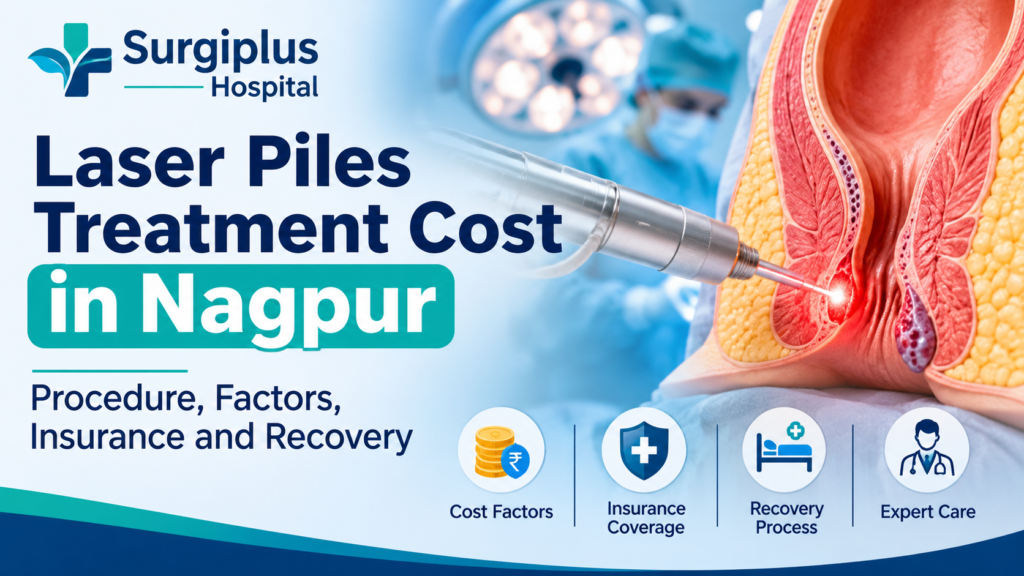
Are you searching for the laser piles treatment cost in Nagpur? The cost of piles surgery can vary from one patient to another because it depends on the grade of piles, the type of procedure required, the surgeon’s assessment, anaesthesia, hospital facilities and postoperative care.
Laser treatment is one of the available surgical options for selected patients with haemorrhoids (piles). However, laser surgery is not necessary for every patient. Some patients can improve with medicines, dietary changes or non-surgical procedures, while others may require surgery.
At Surgiplus Hospital, Koradi, Nagpur, patients are evaluated by an experienced surgeon before deciding the appropriate treatment. This article explains the factors affecting laser piles treatment cost in Nagpur, what a treatment package may include, insurance considerations and how to choose the right treatment.
What Is the Cost of Laser Piles Treatment in Nagpur?
There is no single fixed cost for laser piles treatment in Nagpur. The final estimate depends on the patient’s condition and the procedure recommended after clinical examination.
The cost may include:
- Surgeon and procedure charges
- Laser equipment and operation theatre charges
- Anaesthesia charges
- Preoperative investigations
- Hospital room or day-care charges
- Medicines and postoperative care
- Follow-up consultations
Important: Online cost estimates are only indicative. They may not include all hospital, anaesthesia, investigation or medication charges. Ask the hospital for a written estimate explaining what is included and what may be charged separately.
At Surgiplus Hospital, the exact treatment estimate should be discussed after examination and confirmation of the appropriate procedure.
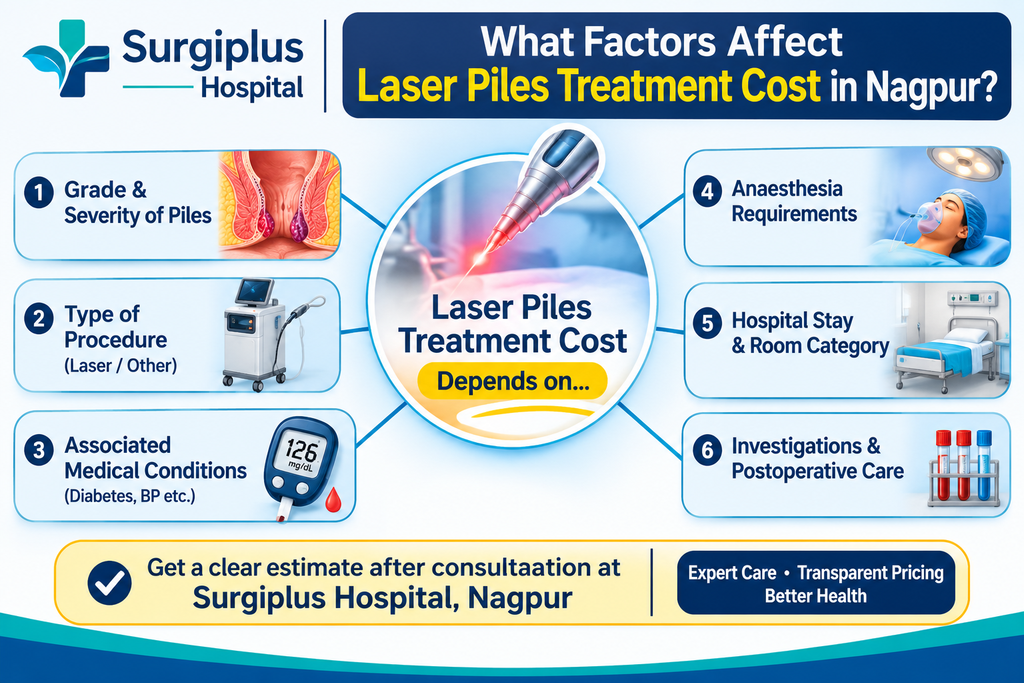
What Factors Affect Laser Piles Treatment Cost in Nagpur?
The cost of laser piles surgery is not the same for every patient. Several clinical and hospital-related factors influence the final amount.
1. Grade and severity of piles
Piles are commonly classified into four grades:
- Grade I: Internal piles without prolapse outside the anus.
- Grade II: Piles prolapse during defecation but return spontaneously.
- Grade III: Piles come outside during defecation and may need manual reduction.
- Grade IV: Piles remain prolapsed and cannot be pushed back easily.
The grade, size, number and location of haemorrhoids help the surgeon decide the appropriate treatment. Advanced or complicated disease may require a different or combined surgical approach.
2. Type of surgical procedure
The term “laser piles surgery” can refer to different techniques. These procedures are not identical.
Depending on the clinical findings, the surgeon may consider:
- Laser haemorrhoidoplasty (LHP)
- Laser-assisted treatment with another procedure
- Excisional haemorrhoidectomy
- Stapled haemorrhoidopexy in selected cases
- Non-surgical procedures such as rubber band ligation
The appropriate technique depends on the internal and external components of piles, prolapse, symptoms and examination findings. A laser procedure should not be selected only because it is advertised as the latest treatment.
3. Associated medical conditions
Patients with diabetes, hypertension, heart disease, kidney disease, obesity or other significant medical conditions may need additional evaluation or perioperative care.
These requirements can affect the total treatment estimate.
4. Anaesthesia requirements
The anaesthesia technique depends on the procedure, patient’s health and anaesthetist’s assessment. Local, regional or general anaesthesia may be considered in different situations.
5. Hospital stay and room category
Some patients may be suitable for day-care treatment, while others may need observation or an overnight stay. Room category and duration of hospitalisation can influence the final bill.
6. Investigations and postoperative medicines
Preoperative blood tests, ECG or other investigations may be advised according to the patient’s age and medical history. Medicines, dressings and follow-up care should also be clarified while discussing the package.
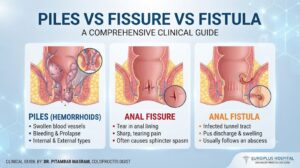
To read about what is fissure , click here
Is Laser Piles Treatment Suitable for Every Patient?
No. Laser treatment is not suitable for every type or grade of piles.
The choice of treatment depends on:
- Whether the piles are internal, external or combined
- Grade and degree of prolapse
- Size and number of haemorrhoidal cushions
- Bleeding, pain and other symptoms
- Previous treatment and recurrence
- Associated fissure, fistula or other anorectal conditions
Some patients with early-stage piles can improve with fibre-rich food, adequate fluids, correction of constipation and appropriate medicines.
Office-based procedures, such as rubber band ligation, may be suitable for many patients with symptomatic Grade I or II and selected Grade III internal haemorrhoids.
Selected patients with large external piles or combined internal and external disease may benefit more from excisional surgery.
A proper clinical examination is essential before deciding on laser piles surgery.
What Is the Difference Between Laser Piles Surgery and Conventional Piles Surgery?
Both laser and conventional surgical techniques have a role in treating haemorrhoids. The best option depends on the patient’s condition rather than the name of the technology.
| Feature | Laser-based procedure | Conventional excisional surgery |
|---|---|---|
| Technique | Uses laser energy in selected procedures | Removes haemorrhoidal tissue surgically |
| Tissue removal | May not require extensive tissue excision | Involves removal of selected haemorrhoidal tissue |
| Postoperative pain | May be less in selected procedures | Can involve more postoperative pain |
| External piles | May need a different or additional approach | Excision can directly address external components |
| Suitability | Depends on haemorrhoid anatomy and grade | Often considered for selected advanced or combined disease |
Neither technique is automatically better for every patient. The surgeon should explain the expected benefits, limitations, risks and recurrence possibilities of the recommended procedure.
How Is Laser Piles Surgery Performed?
The exact steps depend on the laser technique selected.
A typical treatment pathway includes:
1. Consultation and examination
The surgeon reviews symptoms, medical history, previous treatment and bowel habits. An examination, including proctoscopy or anoscopy when appropriate, helps assess the haemorrhoids and exclude other causes of symptoms.
2. Preoperative assessment
Necessary investigations and anaesthesia assessment are completed according to the patient’s health and planned procedure.
3. Anaesthesia
The selected anaesthesia is administered by the anaesthesia team.
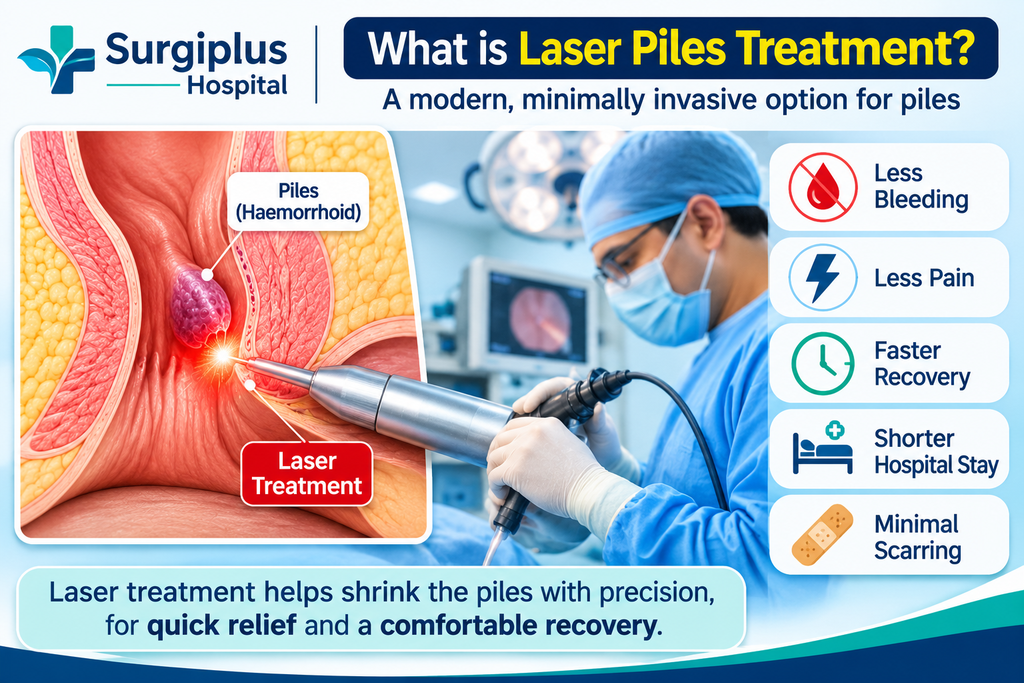
4. Laser procedure
In laser haemorrhoidoplasty, a laser fibre is introduced into the selected haemorrhoidal tissue. Controlled laser energy is delivered to shrink the targeted tissue. Other laser-assisted techniques may involve a different approach.
5. Postoperative observation
The patient is monitored after the procedure. Discharge timing depends on recovery, the type of surgery and the patient’s general condition.
How Long Does Recovery Take After Laser Piles Surgery?
Recovery varies according to the procedure, extent of disease and individual healing.
Some patients return to light daily activities relatively early, while others need more time. It is not medically correct to promise that every patient will recover completely within one or two days.
After surgery, the surgeon may advise:
- Taking prescribed medicines as directed
- Maintaining soft stools and avoiding constipation
- Eating adequate fibre and drinking sufficient fluids
- Avoiding straining during bowel movements
- Maintaining gentle anal hygiene
- Following instructions about activity, lifting and exercise
- Attending scheduled follow-up visits
Contact the treating hospital if you develop significant bleeding, fever, worsening pain, difficulty passing urine or other unexpected symptoms.
Is Laser Piles Surgery Covered by Health Insurance?
Piles surgery may be covered under some health insurance policies, subject to policy terms, waiting periods, exclusions and the insurer’s approval.
Before admission, check:
- Whether your policy covers the proposed procedure
- Whether the hospital is eligible under your insurer’s network or cashless arrangement
- Whether pre-authorisation is required
- Whether room-rent limits, co-payment or deductions apply
- Whether non-medical expenses are excluded
- What documents are required for a cashless claim
At Surgiplus Hospital, patients can enquire about available cashless insurance facilities. Approval is subject to the patient’s policy, insurer or TPA authorisation and applicable terms. Cashless treatment should not be assumed to mean that every expense will be covered.
How to Choose the Right Piles Hospital in Nagpur?
The lowest quoted price should not be the only factor when choosing a hospital for piles surgery.
Consider the following:
- Surgeon’s experience: Check the surgeon’s qualifications and experience in anorectal surgery.
- Correct diagnosis: Ensure that the hospital performs an appropriate clinical examination before recommending surgery.
- Treatment options: The surgeon should explain non-surgical and surgical alternatives.
- Anaesthesia and safety: Ask about anaesthesia assessment, operation theatre facilities and postoperative monitoring.
- Transparent estimate: Request a written breakdown of the expected expenses.
- Postoperative care: Confirm that follow-up and advice for constipation prevention are available.
- Insurance support: Check cashless eligibility and approval requirements before admission.
A good treatment decision should balance clinical suitability, safety, expected outcomes and cost.
Why Consult Surgiplus Hospital for Piles Treatment in Nagpur?
Surgiplus Hospital is a dedicated centre for piles and anorectal conditions in Koradi, Nagpur.
The hospital provides evaluation and treatment for conditions such as:
- Piles (haemorrhoids)
- Anal fissure
- Fistula-in-ano
- Perianal abscess
- Pilonidal sinus
- Other anorectal conditions
Patients are assessed to determine whether medicines, lifestyle modification, an office procedure or surgery is appropriate.
Dr Pitambar Masram, MBBS, MS, FISCP, is a General Surgeon and Coloproctologist with 22 years of surgical experience. He evaluates patients with piles and other anorectal conditions and discusses suitable treatment options based on their clinical findings.
Hospital: Surgiplus Hospital
Address: Near HDFC Bank, Sahyadri Tower, Vanjari Bhavan, Koradi, Nagpur, Maharashtra.
Consultation: Please contact the hospital to confirm appointment availability and the current consultation charges.
Phone: 830-899-6221
Patients can enquire about treatment estimates and cashless insurance eligibility during consultation.
Frequently Asked Questions About Laser Piles Treatment Cost in Nagpur
1. What is the average cost of laser piles treatment in Nagpur?
The cost varies according to the procedure, severity of piles, anaesthesia, hospital stay and other medical requirements. A reliable estimate should be provided after clinical examination.
2. Is laser piles surgery cheaper than conventional surgery?
Not necessarily. The total cost depends on the procedure, equipment, hospital facilities, anaesthesia and postoperative care. The cheapest procedure may not be the most appropriate one for a particular patient.
3. Is laser piles surgery suitable for Grade 4 piles?
Not in every case. Grade IV piles often involve significant prolapse and may have combined internal and external disease. The surgeon must assess whether laser treatment, excisional surgery or another approach is more appropriate.
4. Can piles be treated without surgery?
Yes. Many patients with early-stage piles can improve with dietary changes, adequate fibre, correction of constipation and appropriate medical treatment. Some patients may need office-based procedures. Surgery is considered when clinically indicated.
5. Is laser piles surgery painful?
Pain varies depending on the procedure and the individual patient. Some laser-based procedures may cause less postoperative pain than conventional excisional surgery, but no procedure is completely pain-free. Appropriate postoperative pain management is important.
6. How many days of hospital stay are required?
Some patients may be discharged on the same day, while others may require overnight observation. The decision depends on the procedure, anaesthesia, recovery and associated medical conditions.
7. Can piles come back after laser surgery?
Recurrence is possible after any piles treatment. The risk depends on the procedure, disease characteristics, bowel habits and other factors. Preventing constipation and attending follow-up visits are important.
8. Does health insurance cover laser piles surgery at Surgiplus Hospital?
Patients can enquire about available cashless insurance arrangements. Coverage depends on the insurance policy, hospital eligibility, procedure and insurer or TPA approval.
9. Do I need proctoscopy before piles surgery?
A clinical examination is essential. Proctoscopy or anoscopy may be advised to assess internal haemorrhoids and identify other anorectal conditions. Additional investigations may be required depending on the symptoms and clinical findings.
10. How can I know the exact cost of piles laser treatment at Surgiplus Hospital?
The exact estimate can be discussed after consultation and examination. Contact Surgiplus Hospital to arrange an appointment and understand the recommended procedure and expected expenses.
Conclusion
Laser piles treatment can be a useful option for selected patients, but the cost and appropriate treatment depend on the individual’s condition. Before choosing surgery, it is important to confirm the diagnosis, understand the available treatment options and obtain a transparent estimate of the complete expenses.
If you are searching for laser piles treatment cost in Nagpur, consult an experienced surgeon rather than choosing a procedure based only on advertisements or online prices.
For consultation and treatment guidance, contact Surgiplus Hospital, Koradi, Nagpur.
Medical Author and Reviewer
Dr Pitambar Masram, MBBS, MS, FISCP
General Surgeon and Coloproctologist
Surgiplus Hospital, Koradi, Nagpur
22 years of surgical experience
This article is intended for patient education. It does not replace an individual medical consultation. Treatment decisions should be based on clinical examination and the patient’s medical condition.
References
- American Society of Colon and Rectal Surgeons. Clinical Practice Guidelines for the Management of Hemorrhoids (2024). https://pubmed.ncbi.nlm.nih.gov/38294832/
- NHS. Piles (haemorrhoids): symptoms and treatment. https://www.nhs.uk/conditions/piles-haemorrhoids/